Let's Watch an Investigation in Action
Following the Clues: An AllTrails Copywriting Investigation
Let's try something different.
Instead of just showing a piece of copy, critiquing it, and then rewriting it, I'll walk you through my process of what happens before I write anything at all.
We'll use AllTrails as our test case. Now, if you're not familiar with the app, it helps people discover trails for hiking, biking, running, and other activities. It gives you trail maps, reviews, photos, difficulty ratings, navigation tools, weather and trail conditions, and other important information people can use to plan their outing.
Just to be clear, I don't work for AllTrails, nor do I write for them. That means I don't have access to internal research, strategy, analytics, or testing data. But there is enough external evidence to do this investigation.
I am not recommending nor endorsing AllTrails.
Even though we will begin with the headline for simplicity's sake, this is not an exercise in headline writing.
By the end, you'll understand why good copy doesn't begin with words.
Our goal is to figure out what the whole piece needs to do. So we begin with the following questions:
First, we start out by understanding the prospect.
- Who are we talking to?
- What do they already believe?
- What do they already want?
- What don't they want?
- What do they say they're trying to solve?
- What is it that they're really trying to solve?
- What would cause them to sit uo and pay attention?
- What questions do they have that need answered?
- What obections do they have?
- What obstacles would prevent them from taking action?
- Which product features matter to those objections, and which don't?
- What benefits do those features deliver?
- What are the deep benefits?
- What proof would they need before believing us?
Then we move to understanding the persuasion.
- What should we show rather than tell?
- What should come first?
- What can wait?
- What action should the copy lead toward?
- And probably the most important question—Are we trying to capture demand that already exists, or create demand that doesn't?
The answers we find determine everything… from the foundational argument through the promise to the close. We use them to craft the promise and the story. Because of them, we know which evidence we need. It tells us the order to build our persuasive argument. They'll reveal the features and benefits we emphasize and those we mention only in passing, or not at all. They give us what we need to select the images and the objections we answer. They tell us what our CTA needs to be.
In other words: the copy.
You may have noticed that we knew next to nothing when we began. We ask a question and look for evidence. We see where it leads. That brings us to our next question, and we repeat the cycle.
Some of our hypothesis will stand, others will fall.
Some clues will take to unexpected places.
Step 1: Start With What' Already There
We'll use AllTrails website as our example.*
*AllTrails is used here solely as a public example to illustrate a copywriting investigation. I have no affiliation with the company, and the observations that follow are based entirely on publicly available information.
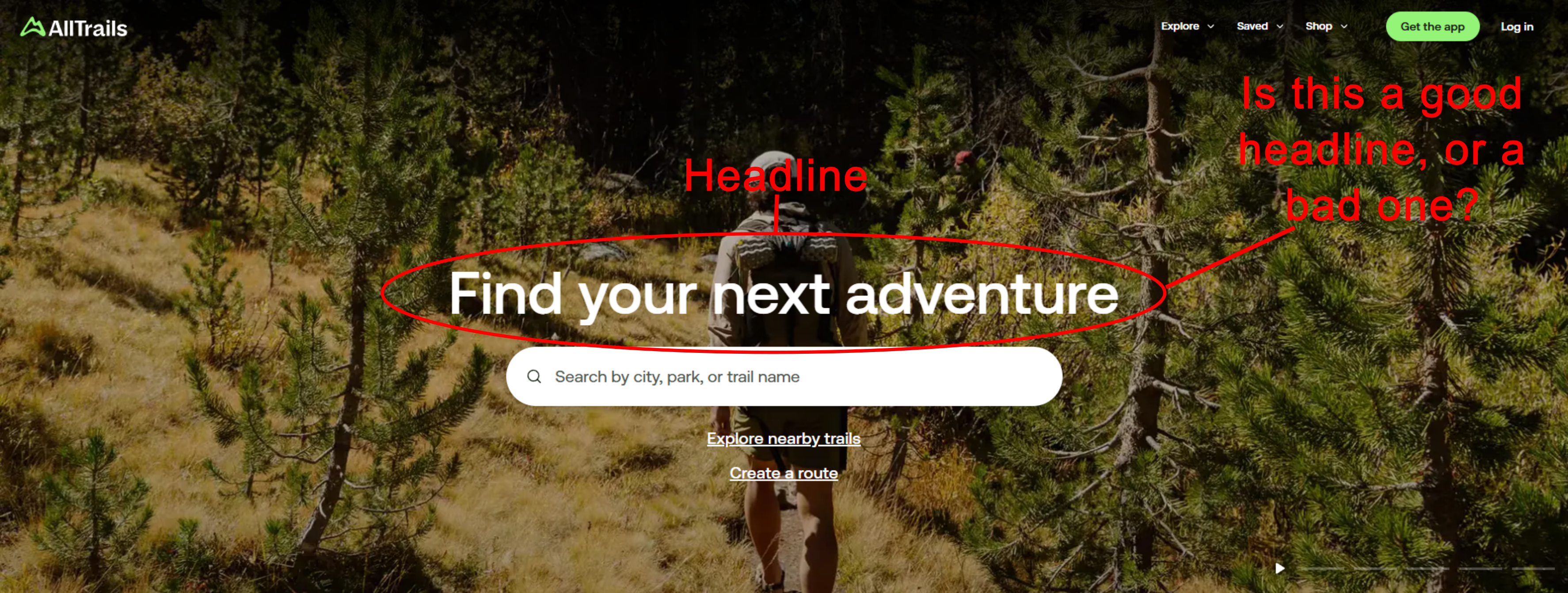
AllTrails headline is “Find your next adventure.”
Do you think this is good headline or a bad one?
That's where a lot of folks start their diagnosis.
I believe we still have more questions to ask first.
- Could we make it more emotional?
- More specific?
- More intriguing?
Well… maybe.
The thing is, we don't know enough yet to answer any of those questions.
We need to step back and ask a set of more fundamental questions first:
What job is this headline supposed to do?
- Who is reading it?
- Why are they on AllTrails?
- What happened immediately before they arrived?
- What do they already know?
- What do they already want?
- What problem are they trying to solve?
- What do they already believe… about themselves, the outdoors, AllTrails?
We don't know any of these things. So, we aren't in a position to judge the headline yet. We need to look for clues.
A search box sits directly below the headline. It asks you to search by city, park, or trail name.
That's a good clue, but let's keep digging.
AllTrails shows us nearby trails… ratings… difficulty … distance… and estimated time.
Are next question should be, “What kind of person needs this information?”
Is it someone who wants to know if outdoor recreation might be fun or enjoyable? Most likely not.
How about someone who needs convincing that hiking is good for them? Again, probably not.
The best shot is probably someone who's already wondering, “I'd like to so somewhere. Where should I go?”
But still, we only have a hypthesis.
Are there any more clues?
Step 2: Where Are These Visitors Coming From?
We have a somewhat limited view on this because we don't have AllTrails' analytics. But third-party traffic estimates that organic search is a major source of traffic.
This clue gives us some context as to what searches might lead someone to AllTrails: hiking trails near me, hiking trails near Los Angeles, etc. or waterfalls near me.
These searches already have something in common. They show intent—not “Should I hike?” but “Where should I hike?”
With the other clues we found on the homepage, we see that this page is targeting demand search where intent is already established.
The target audience wants to go hiking. AllTrails helps them decide where to go.
So maybe the headline “Find your next adventure.” doesn't need fixing because it's doing exactly what it's supposed to do.
Because the intent is to answer “Where should I go?” and AllTrails does that with their headline, we've made our first discovery without having written a lick of copy.
That gives us a useful working hypothesis:
The current homepage appears to tap existing intent… demand capture.
That brings up another question.
Step 3: What Happens if We Change the Assignment?
Here's where things get really interesting and exciting. What if, rather than competing against every other hiking app company for the small slice of the market that is demand driven, we change the game and create demand instead? What if we awaken the latent desires in our prospects and become their guide through the process, becoming the only option and building loyalty before any competitor can even enter the game?
Let's turn our attention back to AllTrails. Imagine they come to us and say, “We're already good at reaching people who are searching for trails. We want to reach those who aren't but are looking for something to do that's outdoors.”
What now? It's the same company… same product… same features. But a totally different strategic problem.
The question is no longer “How do we help someone find the hike they already want?” The question becomes, “How do we make more people want to go?”
Welcome to demand generation.
And that means the headline, “Find your next adventure.” no longer works the same way. The headline's job has changed.
But before jumping into demand generation, we found another question. What about the people in the middle that aren't either cold or hot? They want to hike, but they're simply not going.
Why not?
That's something worth investigating.
Step 4: Why Do People Who Want to Hike Still Hesitate?
The first thing that came to mind was, Safety.
That seemed like a reasonable possibility. After all, hiking can take you into unfamiliar and even dangerous territory.
Navigation matters—people worry about getting lost. AllTrails offers offline maps.
We found one telling comment. There was an online discussion about whether AllTrails' paid version was worth the money. Someone said the offline map had probably, “saved my life once or twice.”
Powerful language for sure. And maybe a clue.
Could it be that AllTrails is actually selling safety rather than trail discovery?
As tempting as that nugget was, one dramatic customer statement doesn't make a solid strategy.
So we kept going… and found something far more interesting. There was another customer talking about offline maps. Their reason? It wasn't safety, but rather the downloaded maps allowed them to be, “more spontaneous.”
What? It seamed strange that a safety feature would make someone feel more spontaneous.
Isn't safety about restraint? Like, “don't wander,” “don't take chances,” or “stick with what you know.” But here was this person describing the opposite. For them, more certainty meant more confidence to explore more freely.
That brings up another question: Does greater certainty change what people are willing to do?
And that's much more interest than safety alone.
That led to looking for people at the exact moment of hesitation.
Step 5: What Does Hesitation Actually Sound Like?
Now, instead of searching for more people who love AllTrails, we broadened the investigation.
The target became people who wanted to hike, but weren't doing it. Why? What stopped them?
One beginner said they loved nature and wanted to experience it themselves instead of just watching videos. They had desire.
They had questions though:
- What equipment do I need?
- Where do I go?
- How does all of this work?
- And finally, they were scared they would get lost.
That was what was holding them back.
Another person wanted to start hiking, but was afraid to go alone. Yet another had already hiked with friends and knew they enjoyed it—but they wanted to become independent enough they didn't have to rely on someone else being available. They had even identified some easier trails… but they were nervous about going solo.
That's when the pattern became visible in one word. BUT.
- I'd love to hike… but I'm afraid to go alone.
- I'd like to try that trail… but I've never been there.
- I'd love to see that waterfall… but I don't know if I can handle the hike.
- I'd like to go farther… but I don't know what conditions are like.
- I'd love to go explore that… but what if I lose service?
- I'd go alone… but what if something happens?
Let's stop and take a look at the structure. Something comes before BUT:
Desire.
Something comes after it: A reason not to act on the desire.
Fascinating. Maybe the conversion problem isn't “How do we make people want hiking more?” but rather “What is preventing an existing desire from becoming action?”
Now that's something concrete enough to investigate one piece at a time.
Step 6: What Are the BUTs?
An objection is simply an unaswered question wrapped up in disguise.
BUT #1: “I don't know where to go.”
That's fair. You want to go outside, but where?
AllTrails lets you discover trails and narrows the options:
- Nearby.
- Easy/Moderate/Hard.
- Short/Long.
- Different activities/Different attractions.
I don't know becomes “Here are several places I could go.””
One certainty reduced.
BUT #2: “I don't know whether I can do it.”
Even if I find some place beautiful, that doesn't mean I'm up for the challenge.
I need to know:
- How long is it?
- How difficult?
- How steep?
- How long will it take?
- Anything else I need to know?
AllTrails provides:
- Distance.
- Difficulty.
- Elevation.
- Estimated duration.
Now I can make a judgment call. My answer might be that it's beyond me and that's okay.
Good persuasion doesn't require pretending every product choice is right for everyone.
I can always choose another trail, like the 2.4-mile easy one.
The important thing is that the “I don't know if I can do it” had become “Yes, I probably can.”
BUT #3: “I don't know what it's really like.”
“Moderate” only tells me so much.
- Is it rocky?
- Muddy?
- Exposed?
- Crowded?
- Shaded?
- Are there stairs?
- Is the view actually worth the climb?
Now AllTrails's photos, ratings, descriptions, and reviews take on a different role. They aren't just content.
They're answering: What am I getting my self into?
I can see the trail… the destination. I can read what people say. So everthing becomes more familiar. Another BUT gets smaller.
BUT #4: “I don't know what it'll be like today.”
Trails change… weather changes—snow … mud… heat… rain… air quality. Recent conditions matter.
That's why AllTrails provides trail-condition and weather information.
The psychological benefit is enormous. It moves beyond here is some data because it answers “What should I expect if I go now?”
We've knocked down another unknown.
BUT #5: “What if I lose cell service?”
That brings us back to what caught our attention in the first place—offline maps.
When we started, we just saw the feature. Now we can see the benefit by looking at it through the customer's hesitation.
“What if my phone loses service and I don't know where I am?”
Download the route.
Remember the two custmers who sent us down this trail? One said offline maps saved their life. The other one, the more revealing one, said offline maps allowed them to be more spontaneous.
Why?
Because the map didn't just solve a navigation problem, but it weakened a reason not to explore.
BUT #6: “What if I take a wrong turn?”
AllTrails has an answer—wrong-turn alerts.
If someone navigating a route wanders to far off course, the app can alert them.
That's the feature. The benefits? Safety, relief, and one less thing to worry about.
BUT #7: “What if I'm going alone?”
Let's get real—this one can't actually be eliminated because solo hiking carries real risk and consideration. We can't pretend otherwise. That would be irresponsible and unethical.
AllTrails does provide tools to address pieces of that uncertainty. Like Live Share. it allows someone else to follow your progress and track your location. Or Community Information that let's you know how active an area is. Reviews lets you learn from people who've already been there.
Does that guarantee safety? Absolutely not. And we wouldn't want the copy to imply that it does.
But can it help someone make a more informed decision about whether they're comfortable going? Certainly.
Now let's put all those BUTs together.
Step 7: Stop Looking at Features
Let's reorganize them.
I don't know where to go.
→ Discovery and filtering.
I don't know if I can handle it.
→ Difficulty, distance, elevation, duration.
I don't know what it's really like.
→ Photos, ratings, reviews.
I don't know what conditions are like.
→ Current conditions and weather.
What if I lose service?
→ Offline maps.
What if I wander off route?
→ Wrong-turn alerts.
What if I'm going alone?
→ Live Share and Community Information
Seven concerns… seven different pieces of the product that are psychologically all performing the same basic job. They all replace, “I don't know…” with “Now I know.”
With that knowledge, we revised our hypothesis. We went from safety to confidence, which is closer. AllTrails already uses confidence language. But confidence seemed more like the outcome rather than the mechanism.
What creates the confidence?
Information… preparation… knowing what to expect… and reducing uncertainty.
So now our working mechanism looked like:
Desire → BUT → information → less uncertainty → greater confidence → action.
That's a nice theory… but is it true?
Step 8: Does Removing Uncertainty Actually Change Behavior?
That's the next question because someone can appreciate information without acting on it—we needed evidence of action. And that's why the “more spontaneous” actually mattered.
We also found solo hikers describing navigation tools as reducing their anxiety about getting lost.
Beginners were advised to choose familiar or well-marked trails and to check for difficulty, distance, elevation, and read reports from other hikers.
Why?
Each piece of information lets someone shrink the unknown until the outting falls within a boundary they're comfortable crossing.
That moves the transformation from Unsafe → safe, which isn't something we could responsibly promise anyway. And it wasn't Afraid → confident either.
It was really “I'd love to…” → “Why not?”
The trail didn't change. The mountain was still the same. The original desire didn't morph… the change was the the number of reasons not to go.
That's how we came to our first major strategic idea: Remove the BUT. Not as a headline or a tagline… as a job for the copy.
If someone already wants the experience, why keep piling desire on top of desire? We actually risk talking them out of going.
Let's identify what comes after: I'd love to… BUT and answer it systematically. Doing so will give us some potentially powerful conversion copy.
Here's the biggest problem with it: It's not demand generation. The person who says, “I'd love to… BUT” already wants something.
What about that person who isn't thinking about hiking at all, but is open to it?
Before we can remove those BUTs, we need to create something worth objecting to.
So we started a second investigation.
Step 9: What Makes Someone Who Isn't Planning to Hike Suddenly Want To?
The first thing is to find a big emotional desire. So we asked:
Why do people become hikers? Is it:
- Exercise?
- Stress relief?
- Mental health?
- Escape?
- Adventure?
- Family connection?
- Nature?
If we could identify some universal motivation, we could build our demand generation on that angle. So we looked. But the evidence didn't support any single angle—people started hiking fo all sorts of reasons… exercise… going somewhere beautiful… friends… photography… travel… an inexpensive activity… childhood exposure… solitude.
The answers were all over the place, but that was useful, because here is where a lot of writers get themselves into trouble.
The writer here often picks their favorite. We could have gone with People hike to escape modern life. That sounds like a fantastic reason and we could have built a great campaign around it.
But the evidence pointed in a different direction. So we asked, “Are we asking the wrong question?”
Maybe instead of “Why did you try hiking?” it's “Why did you want to do it again?”
That took us down a different path altogether.
Step 10: What Happened on Your First Experience?
One person talked about how they disliked their childhood hiking experiences. Then they ended up going on a hike as an adult. It was harder than they expected. It had mud and rough terrain and exhaustion. But when they reached a rocky beach overlooking the Pacific and the mountains, something happened. They realized they'd never felt better.
Upon returning home, they convinced their wife to buy hiking shoes and kept hiking after that.
Another person went hiking during the height of fall colors. Their climb was exhausting, but they made it to the top where the view was breathtaking. Later, they described trying to recreate that feeling from the first hike.
A third person started when they were in college because hiking was cheap. While other entertainment cost money, hiking didn't. But they didn't keep hiking because it was cheap. It was because of the experience.
We found different starting motivations, but the same outcome: The experience created the desire for another experience.
That gave us a new question. What if demand-generation copy shouldn't try to sell someone on the abstract idea of hiking? What if we should them an experience they want instead?
In other words: What if we create THERE?
Step 11: What Makes Someone Say, “I want to go THERE”
We came up with a few things right off the bat. Beautiful scenery was an obvious answer. But what about mountains, lakes, wildflowers, and views?
But beautiful imagery doesn't create action by itself. After all, I can look at an exquisit photo of Patagonia and tell myself, “Someday.”
That's desire. But it's probably not actionable demand.
What is it that moves someone from “That's beautiful” to “Let's go”?
We dug into how hikers actually choose trails.
Sure, scenery matters. But so does distance from home, trail length, difficulty, elevation, duration, ratings, and how interesting the trail was.
Beyond asking, “Do I want that experience?” people were asking, “Is that experience realistically available to me?”
That led to proximity.
Step 12: What Changes When THERE is Nearby?
Imagine a photograph of a spectacular waterfall…in Patagonia.
You might think I'd love to see that someday.
Now think of an equally spectacular waterfall, but underneath the photo… 23 minutes away. That changes the equation.
Now the experience isn't necessarily more desirable… but it is much more possible. So someday becomes Saturday.
Proximity isn't an emotional benefit. It's an accelerant. It collaspes the psychological distance between “I want that” and “I could do that.”
AllTrails can keep going.
“That waterfall? Only 23 minutes away. 2.4 miles of easy terrain. Takes about half an hour. Highly rated. There's parking at the trailhead. Here are some recent reviews and pictures from people who were there last weekend.”
Watch the progression:
That's beautiful.
↓
Wait. Where is that?
↓
That's near me?
↓
It's only 2.4 miles?
↓
I could do that.
↓
“We should go Saturday!”
Just a short while ago, I wasn't looking for hike. I probably wasn't even thinking of one to be honest.
Notice that no one had to convince me that hiking is good for my health, or that screen time isn't. No one talked me into more adventure.
The experience became imaginable and then desirable, and then something within my reach. And that desire? I supplied that.
Another nice theory.
But can we find any evidence of people actually behaving like this?
Step 13: Does AllTrails Actually Generate This Behavior?
We found a beginner who was essentially asking how to even start hiking. They wanted to know if they should just look up random trails.
Someone recommended AllTrails to find nearby hikes where you can filter by difficulty and length. And then they said that's how they got into it (hiking).
Wow! What a reveal. AllTrails didn't just help with navigation, but actually helped someone get into hiking.
A few folks described their weekly routine. They would browse AllTrails and find trails that appealed to them. They'd save their searches, and then when the weekend came, they would choose one and go.
For them, the sequence became Browse → See → Want → Save → Go.
The trail wasn't the answer to a search. Discovery was the key that helped create a future outting.
There's the evidence that our hypothetical demand-generation mechanism already happens inside the product.
That raised another question.
Step 14: Who Should We Actually Target
Easy… non-hikers, right?
Actually… no. Yes, the category is huge, but it's mostly useless for our purposes. Here's why.
Someone who hates walking, nature, and has absolutely no interest in outdoor recreation is a non-hiker. Why spend money trying to convert them?
The investigation pointed to someone much more interesting… someone who likes beautiful places, enjoyes being outside. They might walk. Perhaps they occasionally hike while on vacation. Maybe they used to hike. They might be followers of travel and nature accounts. Maybe they take their kids outside occassionally.
They might even think, “We really should get outside more.” But they don't currently identify themselves as hikers, so they're not currently searching for trails.
It's not that they don't have the desire—the desire is just dormant. It's latent demand.
That makes a difference as demand generation usually doesn't mean creating desire from nothing. Instead, it usually means taking an existing but inactive desire and fanning it until it becomes strong enough to act on.
That's a highly attractive audience.
That brings us to needing to understand what we're competing against.
Step 15: What is the Real Competition?
Here's what came to mind: Netflix. Then the couch. Scrolling social media. Restaurants. Shopping. Errands. —Just another ordinary Saturday.
While all of those compete for time and attention, we dug deeper, asking, “Does someone really wake up and consciously choose between Netflix or hiking?
Probably not. It might happen… sometimes. But most people aren't rejecting hiking. It just never occurs to them, so it doesn't enter into the decision.
When someone asks, “What should we do today?” the answer is frequently, “I don't know.” There's a vacuum, and somethng familiar rushes in to fill the void.
That suggests the real demand-generation competitor is most likely not another hiking app, Netflix, or the couch. It's much more like, “Nothing occured to me.”
That creates a different scenario. Our job isn't actually to convince prospects that hiking is better than Netflix, but to add hiking to the consideration set.
Show something that makes prospects stop and ask, “Where is that? You're telling me it's close and doable?”
Now the prospect has an option they didn't have moments ago. But before we get too excited about that idea, we need to see if it makes sense competitively.
Step 16: What Do the Competitors Own?
We looked at several of AllTrails' major competitors.
Gaia GPS
Gaia has strong mapping and navigation capabilities, whose values becomes especially apparent once someone is already planning or undertaking an outdoor route.
onX Backcountry
onX leans into terrain intelligence, detailed mapping, backcountry planning, and making better decisions in more serious outdoor environment.
The language they use indicates a certain identity—backcountry, terrain, summits, topo maps—that person is already going.
Komoot
Komoot is the most interesting entry for our hypothesis because it combines route planning with discovery and inspiration. It has community routes, highlights, viewpoints, lakes, and waterfalls.
So we can't say that no one else is doing inspiration because that would be false as Komoot clearly operates in some of this territory.
But that raises a better question: “What does AllTrails appear to be unusually good at?”
That's when stopped listening to the companies and turned to customers and how they differentiated between them.
Step 17: How Do Customers Describe the Difference?
A pattern emerged. People who preferred Gaia for serious navigation still described using AllTrails to find trails. Those who liked other mapping tools still went to AllTrails for discovery. Some found trails in AllTrails and then used something else to navigate.
A golden nugget. Even when another product wins the technical navigation job, AllTrails often wins an earlier psychological job: “Where should I go?”
That's exactly where our demand-generation hypothesis lives.
We're not asking AllTrails to become something it's not, but rather what would happen if we deploy one of its existing strengths earlier in the customer's decision process?
AllTrails already answers the question “Where should I go?”
Maybe demand-generation copy could make someone ask that question before they had any intention of going.
Step 18: Now Watch What Happens to the Copy
Whew, that was quite a trip!
Time to circle back to where we began… the headline “Find your next adventure.”
When we started, we didn't know if it was good copy or not. Now we can answer that more intelligently. The answer is it depends on the job.
But it's just as important to remember that when we change the job, it changes more than the headline, but everything that follows it.
Let's take on our prospects one at a time.
Assignment #1: Capture existing intent.
The prospect arrives wanting to hike. They want to know where to go. The job of this copy is pretty much functional: help them find the right trail quickly. The headline makes sense for this prospect.
When we look beyond the headline, we can answer what should come immediately after. AllTrails does a nice job of this already, using search, displaying nearby trails, etc.
This visitor doesn't need a 1 ,500-word argument covering why hiking will transform their life. That would only get in the way as they've already decided to go.
The copy should help them go. Nothing more. The hero needs to help them discover where. The body copy needs to make choosing easier. The product information should help compare options. The proof needs to reduce uncertainty around the trail. The CTA should move the visitor toward finding or selecting one. And the whole page architecture follows the visitor's existing intent.
That's demand capture.
Let's change the prospect and watch what happens.
Assignment #2: Convert existing desire.
This prospect thinks “I'd love to go… BUT.”
Now the job isn't really about discovery as it's about hesitation removal.
That changes the direction of the headline and the rest of the copy.
For the headline, we can start experimenting with ideas such as, “Fewer reasons to wonder. More reasons to go.”
That's just for illustration—not final copy.
Next, we move onto working on the body copy. Our research shows what that copy needs to do now.
It needs to surface and answer the BUTs. The testimonials need to turn an unknown experience into something the prospect can picture and evaluate.
So we now know what testimonials we'll need for this prospect. Not “Great app! Five stars!” Those won't do anything for us. We want evidence of the transformation we're claiming. Like someone who ventured somewhere they otherwise wouldn't have gone or who became comfortable while trying unfamiliar trails.
The CTA is likely to change as well. So not Search trails, but something like Explore boldly.
Let's look at demand-generation.
Assignment #3: Generate Demand
This person isn't thinking about hiking at all. Our original headline won't connect with them. Instead, we need to start with THERE. Show them something—a place they didn't know existed.
The visual becomes a part of the sales argument. It might even be the first thing doing the selling. Next, give the image context… “You had no idea this was 23 minutes away.”
We create curiosity, then desirability, and finally attainability.
First, we show THERE, then make THERE relevant. Next we make it attainable. After that, we anticipate the BUT, then we remove the BUT. Then we finish by giving the next step.
Step 19: The Investigation Changed More than the Headline
When we put all three assignments next to each other, we find three very distinct headlines and three very different bodies of copy. And if we try to mix them to address everyone, we address no one. If we want to capture all three segments, we need three distinct funnels.
This is the copywriting process in action.
Remember, when we started, we didn't know any of this. We started with the current headline and worked our way through by asking questions and doing research to find the answers. We then let our answers determine the direction we took and the copy we wrote.
Only after doing all of that can we honestly answer, “What should the copy say?” We need to know the actual strategy before we write.